


Yes — sand candles are safe to burn, and in several ways they reduce the most common candle risks: no large pool of hot liquid wax, no overheating glass jars, no paraffin or synthetic additives. They burn cleanly, refill without scraping, and meet the same fire safety standards as traditional candles.
Why Sand Candles Are Designed to Feel Safer

No large pool of hot liquid wax
Traditional candles create a wide melt pool of liquid wax as they burn — a spill risk and a source of uneven burning. Sand candles work differently: only the granules immediately surrounding the wick melt during use. The rest of the wax stays cool and intact in the vessel.
Less risk from overheating containers
Glass jar candles can become dangerously hot after long burns — hot enough to crack or cause burns on contact. With sand candles, you choose the vessel. A thick ceramic bowl, a metal tin, or a heat-safe glass cylinder all distribute heat more safely than thin-walled candle jars.
Cleaner-burning wax
Candella sand wax is made from RSPO-certified palm wax — no paraffin, no synthetic binders, no petroleum byproducts. When burned with a properly placed wick, it produces minimal soot and no black residue on your walls or ceilings.
Refillable — so no burning down to the bottom
One of the most common candle hazards is burning a jar candle too low, which can overheat the container or ignite the label. With sand candles, you top up the vessel before it runs low. The format eliminates that risk entirely.
Sand candle safety vs traditional jar candle safety
| Risk | Sand Candle | Traditional Jar Candle |
|---|---|---|
| Hot wax pool | Minimal — only granules around wick melt | Wide melt pool of liquid wax |
| Soot | Minimal — RSPO palm wax burns clean | Common with paraffin candles |
| Burning to bottom | Eliminated — refill before vessel runs low | Fire hazard if not supervised |
| Wax composition | RSPO palm — no paraffin, no synthetic binders | Often paraffin (petroleum-derived) |
Sand Candle Safety: What You Still Need to Know
No candle is risk-free. Open flame always requires attention — regardless of wax type. Follow these guidelines for every burn:
- Use a stable, heat-resistant vessel — ceramic, metal, or thick glass
- Trim the wick to ¼ inch before every burn
- Keep away from curtains, paper, pets, and children
- Place on a flat, non-flammable surface
- Avoid strong drafts or fans — they cause uneven burning and excess smoke
- Never leave a burning candle unattended
- Let wax cool fully before moving the vessel
Wick placement is the single most important safety factor with sand candles. A wick that's off-centre or too deep will cause uneven burning and excess heat. → Read our wick placement guide for a safe, even burn
Sand candle safety, by the numbers
- Cotton wicks burn approximately 25% cooler than zinc- or lead-core wicks, per the National Candle Association. Candella uses cotton wicks exclusively.
- All Candella wax meets ASTM F2417, the international fire safety standard for candles — the same one used by traditional soy and beeswax candles.
- Candella's RSPO-certified palm wax contains no paraffin, no petroleum byproducts, and no synthetic binders.
- The most common candle hazard — burning a jar candle to the bottom, where heat can ignite labels or crack glass — is structurally eliminated by the sand candle format.
- Trim your wick to ¼ inch (6mm) before each burn — this can reduce flame height by ~40%, the single highest-impact safety practice for any candle type.
Who Sand Candles Are Especially Good For

- Eco-conscious homes — no single-use containers, RSPO-certified wax
- Entertaining and dining tables — pour into any vessel to match your aesthetic
- Custom home décor — same wax, completely different looks across spaces
- Thoughtful gifting — the Discovery Scent Bundle lets recipients explore scents before committing
- Anyone frustrated by tunnelling or wasted wax — sand candles don't tunnel
Not sure which scent to start with? The Discovery Scent Bundle includes Lavender Fog and three other curated scents — the lowest-commitment way to try sand candles for the first time.
"Safety isn't a feature we add — it's the floor we build on. RSPO-certified wax, cotton wicks, ASTM F2417 compliance: these aren't bullet points on a marketing page. They're the minimum standards we'd put in our own homes, around our own families."
Amy, Founder of Candella
The Bottom Line
Sand candles are safe — and for many households, they're a smarter, lower-waste alternative to traditional candles. The wax is clean, the format is refillable, and the risks are manageable with basic candle care.
The one thing that matters most: proper wick placement. Get that right and you'll have a safe, beautiful burn every time.
Ready to try it? Explore the full Candella collection →

Eco Sand Candle Discovery Set – 6 Scents
A sand candle is a pourable candle made from granulated wax that can be used in any heat-safe vessel. Pour ...
Learn more →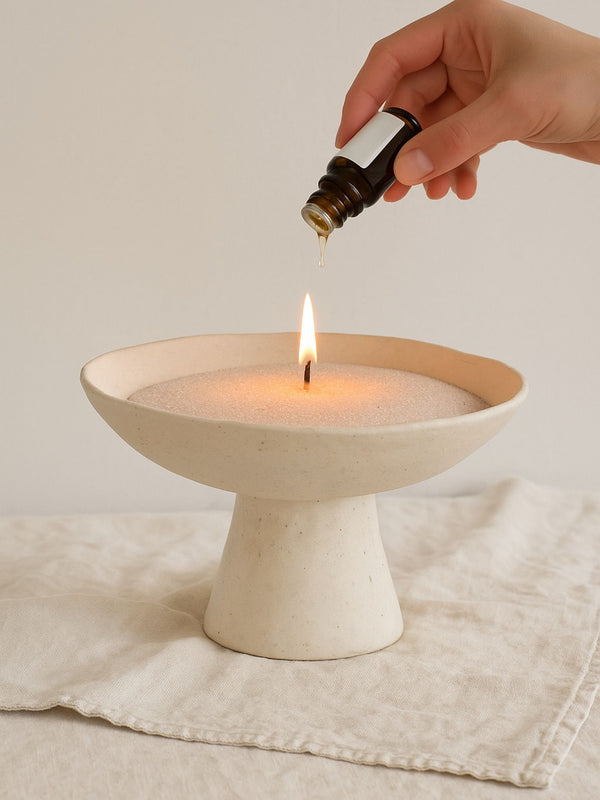
Original Unscented
A sand candle is a pourable candle made from granulated wax that can be used in any heat-safe vessel. Pour ...
Learn more →
Lavender Fog
A sand candle is a pourable candle made from granulated wax that can be used in any heat-safe vessel. Pour ...
Learn more →